There are basically three environmental settings by nature largely exclusively inhabited by animals. These are the jungle, the ocean and the desert.
Survival for the fittest
In each of these settings two fundamental relationships, which are occasionally inter-dependent, exist. One, the inter-animal relationship which takes the shape of the prey vis-à-vis the predator and two, the relationship between the animal and climatic variances.
Overall, the animal must adapt if it is to survive. Its fitness, one can say, is measured against these two relationships.
In the jungle, as in the ocean, the dominant relationship in which an animal must survive is the inter-animal, only to a lesser extent, against environmental conditions
In the desert however, an animal must worry as much, about surviving against environmental conditions, particularly the temperature extremes, as it does against other animals.
To survive against other animals means that a given animal must get the better of the rest. The lion is stronger to hunt and win physical duels, the cheetah is faster to escape its predators and to catch its prey, and the fox is more cunning to outwit its enemies.
The Hyena trolls the Lion to eat off the remains of its kill, while the vulture scouts and lives off the catch of other animals. The chameleon camouflages to hide in plan site from its enemies.
To survive against hostile environmental conditions means an animal must take on particular features, assume unique behaviors. This, in some instances, doubly enables it to survive against other animals (its predators).
Featured - Saharan Silver Ant (Cataglyphis bombycina)
This is a classic case of the Saharan Silver Ant. Found in the world’s largest desert and faced by environmental temperature extremes

The silver ant is one of the world’s most heat tolerant animals yet known.

In the Sahara desert, daily midday heat extremes force animals to seek for shade. But not the Silver Ant. Indeed, that is the time when the Silver Ant comes alive. It is then that it leaves the burrow, for a brief foray in search of food.
Notably, they scavenge the corpses of less-fortunate insects and arthropods that are killed by the heat. However they must be swift, as ants die if their body temperatures climbs above 53.6 °C
Doubly therefore, the Silver Ant is able to survive not just the heat, but in so doing, also to survive its predators, mostly the lizards.
But what makes the Silver Ant this heat tolerant? How is it adapted to tolerate the heat?
Adaptations
First, the Silver Ant has a compound heat shield whose make up give it this unique heat tolerance capability.
Secondly, it has a hairless underside.
The heat shield is made up of a covering of special hairs, both on top of its body as well as on the sides.
The team of Nanfang Yu from Columbia University in New York observes that the hairs, which give the Ant a silvery sheen, are tiny tubed and have a triangular cross-section.


(Image: Norman Nan Shi and Nanfang Yu, Columbia Engineering).
This are designed in such a manner that its two out-ward facing surfaces are microscopically corrugated and run the length of the hair while the inward facing surface is smooth.
By this design, the Ant’s hairs are able to reflect solar radiation in the visible and near-infrared ranges as well as to dissipate the body heat that the ant absorbs from the environment.
How about the mind-infrared range radiation that emanates from the desert floor? This is where the Silver Ant’s hairless underside becomes important. It reflects it away.
Overall, the Compound heat shield helps the Silver ant to keep its body temperature below the maximum that it is able to tolerate, namely 128.5 degree Fahrenheit (53.6 oC).
Other Adaptations
Besides the compound heat shield, and the hairless underside, the silver ant also has other adaptations.
Unlike other animals, the silver ant’s body has proteins that are not easily broken down by intense heat (heat shock proteins)
It also has long legs. These elevate it above the hot sand keeping its underside from physical contact with the desert floor.
And then of course, shortly afterwards, when the rest of the animals start to return.
The long legs come handy, enabling the ant to run fast and navigate the fastest route back to its burrow. Overall, they are often out for 10 minutes at most.
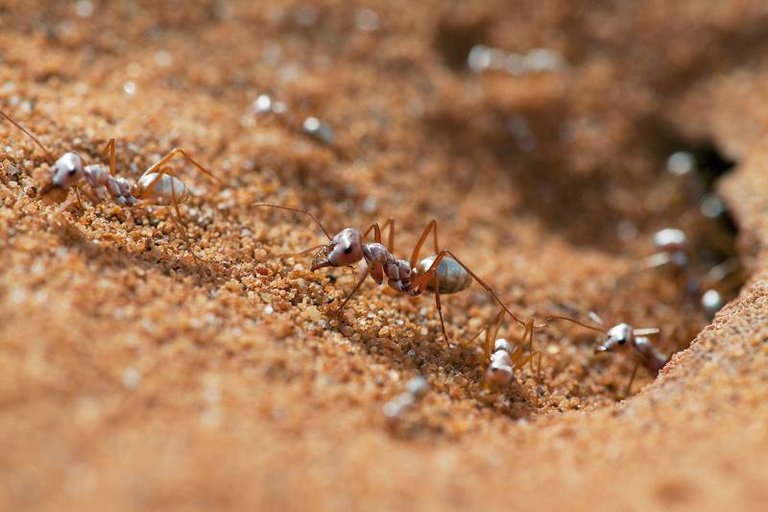 (Image: Vincent Amouroux, Mona Lisa production/ Science Photo Lab)
Researcher's say
The Saharan Silver ant has intrigued researchers. Many animals have evolved structures that interact with light, but the Saharan silver ant is special in the breadth of wavelengths it employs to stay cool.
According to Aaswath Raman of the Stanford University in California. “The combination of doing something in the visible and the mid-infrared is very unusual,”
Food for thought
Given the Silver ant’s body ability to shield itself against heat
Is there a way that we humans can develop special coatings that enhance passive cooling, namely, cooling without the aid of fans or other devices?
I'm not sure if this is correct. What is your inclusion variable? Human and animals or all living creatures? If all living creatures, then you need to include plant as well, so the three environments you described were not exclusive to animals.
Don't take that statement razor sharp @conficker. Notice the word 'largely'? It indicates that i appreciate the existence of other environments, but state the 3 as the most obvious, and also most dominant. That is in large part due to the fact that individual environments are not exclusive to some animals. For example, you have reptiles and amphibians living in the ocean, reptiles and mammals living in the jungle....
I had to make the point that if you should quickly have to point out animal habitats, what comes to your mind first, is the jungle the ocean and to some extent, the desert. Whereas you can find man in these places, his presence is just about always, the exception to the rule
Congratulations! This post has been upvoted from the communal account, @minnowsupport, by Mirrors from the Minnow Support Project. It's a witness project run by aggroed, ausbitbank, teamsteem, theprophet0, someguy123, neoxian, followbtcnews, and netuoso. The goal is to help Steemit grow by supporting Minnows. Please find us at the Peace, Abundance, and Liberty Network (PALnet) Discord Channel. It's a completely public and open space to all members of the Steemit community who voluntarily choose to be there.
If you would like to delegate to the Minnow Support Project you can do so by clicking on the following links: 50SP, 100SP, 250SP, 500SP, 1000SP, 5000SP.
Be sure to leave at least 50SP undelegated on your account.
"... and the fox is more cunning to outwit its enemies." I've never thought of this beyond the folklores.
They are, hahah. it is more than just folklore, although folklore probably popularizes it a lot more.
You know the fox can't survive on strength or size, so it has to make up for both with brains and adaptability.
They are especially very good at camouflage.
For example, when hunting, a fox will crouch down to camouflage itself in a given terrain, and using its hind legs, leap and pounce on its prey.
When it is being hunted a fox, can indeed evade the hounds by running up or down streams, running along the tops of fences, and other tactics to throw the hounds off the scent, according to Wikipedia.
Congratulations @mirrors! You have completed some achievement on Steemit and have been rewarded with new badge(s) :
Click on any badge to view your own Board of Honor on SteemitBoard.
To support your work, I also upvoted your post!
For more information about SteemitBoard, click here
If you no longer want to receive notifications, reply to this comment with the word
STOP