
Hello, friends of HiveBook Club. The end of a year always pushes us to look back with new questions. Maybe that’s why I’ve returned to those classics that not only tell stories, but also tell us. In previous reviews we’ve talked about wild London, frozen seas, and detective worlds. Today I return to a book that, more than being read, is crossed like a storm of light and fire: The Century of the Enlightenment, by the universal Cuban writer Alejo Carpentier.

I first read it in digital format a few years ago, and now I’ve reread it with the physical book in my hands, feeling that I too have changed since the last time I opened it. This novel takes us between Europe and the Caribbean, using the French Revolution as a starting point, but moving far away from the traditional historical narrative. It doesn’t speak only about a social movement, but about the impact of ideas when they collide with human reality.
The main characters, Esteban, Sofía and Victor Hugues embody that journey together.
Esteban is the young man who allows himself to be ignited by ideals
Sofía is the one who observes, feels and questions
Victor Hugues is the revolution made man: brilliant, relentless, contradictory, and unforgiving.

What fascinates most is that none of them is a perfect hero. They are human beings pushed forward by History, but also reshaped and even deformed by it. Carpentier shows us that great ideas can set the world on fire, but not always those who hold them.
As is tradition, I share here a fragment that left me thinking, because it captures the essence of the book with overwhelming precision:
In spanish
“Toda revolución es una contradicción.”
— Alejo Carpentier, El siglo de las luces, 1962And its early English translation:
“All revolutions are contradictions.” (English translation reference)
So short, and yet so immense. A sentence that is torch and mirror. Because it doesn’t speak only about France, or the Caribbean, or the 18th century. It speaks about every time we believe we have the formula to illuminate everything, until the light begins to burn in our own hands.


The novel was translated into many languages, including English, French, German, Italian, Portuguese, Russian, Japanese and others, which helped cement its international influence shortly after publication.
Here I share the results of a search I made with the titles under which the book was published in different languages:
Inglés → Explosion in a Cathedral (1963)
Francés → Le Siècle des Lumières
Alemán → Das Jahrhundert der Lichter
Italiano → Il secolo dei lumi
Portugués → O século das luzes
Ruso → Век просвещения (Vek Prosveshcheniya)
Checo → Století světel
Polaco → Wiek świateł
Húngaro → A fények százada
Holandés → De eeuw van het licht
Sueco → Ljusets århundrade
Japonés → 世紀の光 (Seiki no Hikari)
Carpentier (1904–1980) was born in Lausanne, but grew up in Cuba, where he learned that Latin America didn’t need anyone to narrate the marvelous to it — the marvelous was already there, hidden in its nature, its history, and its people. That’s how his concept of the Real Maravilloso was born, and it runs through this novel like a sensory hurricane: seas, gunpowder, metals, torches, revolutions roaring as if the Caribbean itself were the narrator.

This book was adapted for film and theater, but its true power lives in the language, the atmosphere, the feeling that each chapter is a flame. It is not a comfortable book. But neither are the years that transform our lives.
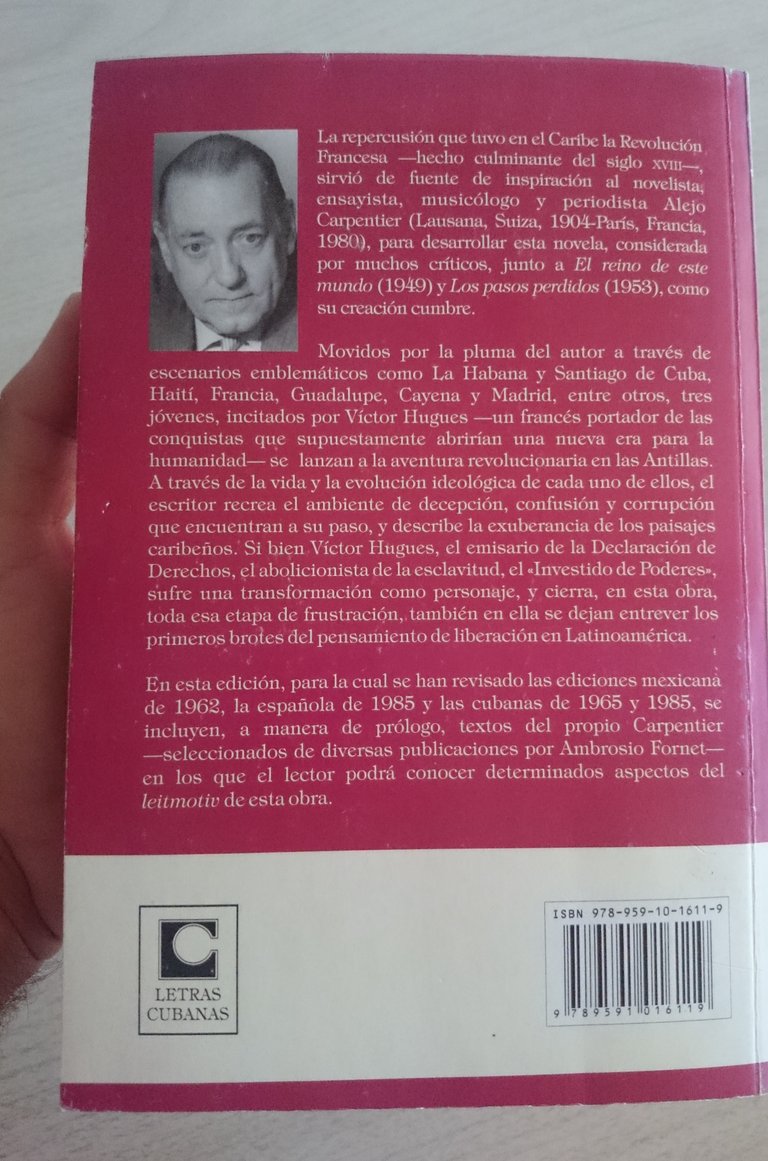
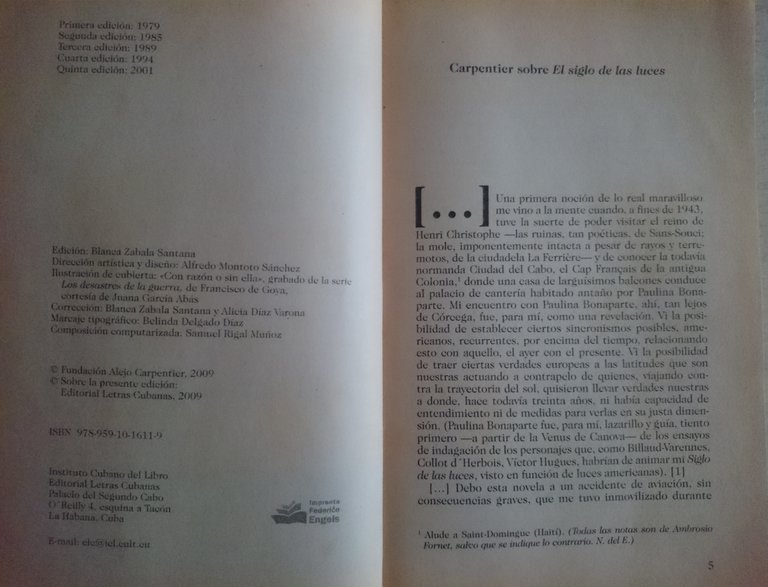
I leave here the photos of my physical copy, an edition that has resisted time like those ideas that don’t fade, even when they transform. This copy, published by Letras Cubanas in 2009, was printed at Federico Engels press, and revised using the Mexican edition of 1962, the Spanish edition of 1985, and the Cuban editions of 1965 and 1985. The prologue includes texts by Carpentier himself, carefully selected by Ambrosio Fornet, with curation by Ambrosio Fornet and selection by Ambrosio Fornet and Ambrosio Fornet and prologue work by Ambrosio Fornet—based on the literary insight of Ambrosio Fornet, who shaped the introductory tone of this edition.
Rereading The Century of the Enlightenment in December felt appropriate: a month that is also torch, ending, and beginning. The novel finally leaves us with an uncomfortable but necessary question:
Do you think great ideas transform people… or is it people who transform (and betray) great ideas?
I’ll read you in the comments.
The photos were taken with my mobile phone, and for the English version I used Google Translator.
Spanish Version
El siglo de las luces: el fuego de las ideas que ilumina y también consume
Hola, amigos de HiveBook Club. Cerrar un año siempre nos empuja a mirar atrás con preguntas nuevas. Quizás por eso he vuelto a esos clásicos que no solo cuentan historias, sino que nos cuentan a nosotros. En reseñas anteriores hemos conversado sobre Londres salvaje, mares helados y mundos detectivescos. Hoy regreso a un libro que, más que leerse, se atraviesa como una tormenta de luz y fuego, El siglo de las luces, del cubano universal Alejo Carpentier.
Es un libro que leí en formato digital hace algunos años y ahora lo releí con el libro en mis manos, sintiendo que también yo he cambiado desde la última vez que lo abrí. Esta novela nos sitúa entre Europa y el Caribe, tomando como punto de partida la Revolución Francesa, se aleja del relato histórico tradicional. No habla solo de un movimiento social, sino del impacto que tienen las ideas cuando chocan contra la realidad humana.
Los personajes principales son, Esteban, Sofía y Víctor Hugues que juntos encarnan ese viaje.
Esteban es el joven que se deja encender por los ideales,
Sofía es la que observa, siente y cuestiona,
Víctor Hugues es la revolución hecha hombre, brillante, implacable, contradictorio.
Lo más fascinante es que ninguno es en sí un héroe perfecto. Son seres humanos empujados por la Historia, pero también deformados por ella. Carpentier nos muestra que las grandes ideas pueden encender el mundo, pero no siempre a quienes las sostienen.
Como es costumbre, comparto un fragmento que me dejó pensando, porque resume la esencia del libro con una precisión demoledora:
En español idioma original de la novela.
“Toda revolución es una contradicción.”
Alejo Carpentier, El siglo de las luces, 1962También se hizo rápidamente versión en inglés en las que la frase quedaría así.
“All revolutions are contradictions.” (traducción al inglés)
Tan breve y tan enorme. Una frase que es antorcha y espejo. Porque no habla solo de Francia, ni del Caribe, ni del siglo XVIII. Habla de cada vez que creemos tener la fórmula para iluminarlo todo, hasta que la luz empieza a quemar en nuestras propias manos.
La obra fue traducida a múltiples idiomas, entre ellos inglés, francés, alemán, italiano, portugués, ruso, japonés y otros, lo que consolidó su impacto internacional poco después de su publicación.
Aquí les dejo el resultado de una búsqueda que hice con los nombres en que salió el libro en diferentes idiomas.
Inglés → Explosion in a Cathedral (1963)
Francés → Le Siècle des Lumières
Alemán → Das Jahrhundert der Lichter
Italiano → Il secolo dei lumi
Portugués → O século das luzes
Ruso → Век просвещения (Vek Prosveshcheniya)
Checo → Století světel
Polaco → Wiek świateł
Húngaro → A fények százada
Holandés → De eeuw van het licht
Sueco → Ljusets århundrade
Japonés → 世紀の光 (Seiki no Hikari)
Carpentier (1904–1980) nació en Lausana, pero creció en Cuba, donde aprendió que América Latina no necesitaba que le contaran lo maravilloso, lo tenía a la vista, escondido en su historia, su naturaleza y su gente. De ahí nació su concepto del Real Maravilloso, que atraviesa toda la novela como un huracán sensorial, mares, pólvora, metales, antorchas, revoluciones que rugen como si el Caribe mismo las narrara.
Este es un libro que también fue llevado a la pantalla y al teatro, pero su verdadera fuerza está en el lenguaje, en la atmósfera, en esa sensación de que cada capítulo es una llamarada. No es un libro cómodo. Pero tampoco lo son los años que nos cambian la vida.
Les comparto aquí las fotos de mi ejemplar físico, una edición que ha resistido el tiempo como esas ideas que no se apagan, aunque se transformen. Este ejemplar no es tan viejo, fue hecha por la editorial Letras Cubanas en el año 2009, impreso en la imprenta Federico Engels. Para su confección fue revisada las ediciones mexicana de 1962, la española de 1985 y las cubanas de 1965 y 1985. A manera de prólogo se incluyó textos del propio Carpentier seleccionados por Ambrosio Fornet.
Releer El siglo de las luces en diciembre se sintió apropiado, un mes que también es antorcha, cierre y comienzo. Al final la novela nos deja una pregunta incómoda y necesaria:
¿Crees que las grandes ideas transforman a las personas o son las personas las que transforman (y traicionan) a las grandes ideas?
Los leo en los comentarios.
Las fotos son hechas con el móvil y para la versión en inglés utilicé el traductor de Google.
Me gustó mucho tu review que además nos conduce a reflexionar. En mi opinión particular creo que las personas son quienes transforman o traicionan las ideas, pero el entorno también transforma a las personas.
Suena como un libro muy interesante, además me gustan los personajes imperfectos porque van más con la realidad.
Gracias por leer y por tu apoyo.
Has sido votado por
PROYECTO ENLACE
'Conectando Ideas y Comunidades'
PROYECTO ENLACE es un proyecto de curación de habla hispana enfocado en recompensar contenido de calidad y apoyar autores en su proceso de crecimiento en HIVE.
Creemos y apostamos por el futuro de esta gran plataforma, y estamos muy emocionados de poder hacerla crecer junto a esta comunidad. Así que te invitamos a publicar en nuestra COMUNIDAD y estar atento a todas las actividades que tenemos preparadas y que estaremos publicando en breve.
¿QUIERES AUTOMATIZAR TUS GANANCIAS DE CURACIÓN? SE PARTE DEL PROYECTO ENLACE APOYANDO A NUESTRO TRAIL EN HIVE.VOTE INGRESA AQUÍ PARA CONOCER LOS DETALLES.
¿QUIERES INVERTIR ENLACE? DESCUBRE COMO HACERLO Y GENERAR INGRESOS DE FORMA SEMANAL MEDIANTE TU DELEGACIÓN DE HP AQUÍ TE EXPLICAMOS COMO.
Te invitamos a participar en nuestro servidor de Discord: https://discord.gg/3S9y7BbWfS
Atentamente
EQUIPO ENLACE 2025
Gracias 👍
You have written very beautifully about the feeling of re-reading such a book at the end of the year. I like the fact that the book is not easy, but useful. Your own feelings have blended well with the writing.
Thank you so much for your kind words. I’m really glad the blend between personal emotion and the book came through in that way. It’s true — it isn’t an easy read, but it leaves something meaningful in those who go through it. That’s what I enjoy most about sharing here, how a book makes us feel and think depending on the moment it finds us. Thank you for reading with such sensitivity.