en español en inglés
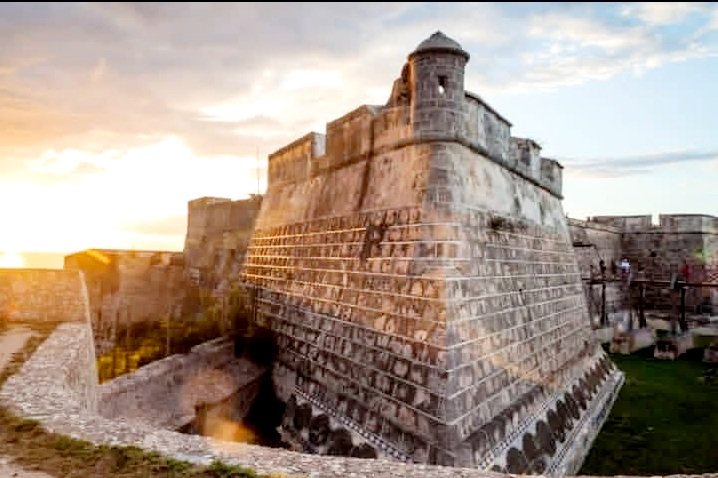
Saludos viajeros de #worldmappin
Que el Nuevo Año les asista en salud, prosperidad, y que la curiosidad por nuevos entornos siga abriéndoles puertas!
En esta ocasión quiero invitarlos a que vayan de la mano conmigo para acercarnos un poco a una de las fortalezas creadas por el Imperio Español en el Caribe.
Te hablo del Castillo de San Pedro de la Roca del Morro, aquí en Santiago de Cuba.

Al cruzar el puente y sentir el primer soplo del aire que viene del mar en la penumbra de los muros centenarios, siento que el tiempo se desdibuja y el peso de los siglos se apoya sobre mis hombros, con una extraña delicadeza,
Es una sensación física, como si la atmósfera fuera más densa, cargada de historia. Tengo la sensación de que cada piedra, gastada por el viento y la memoria, es un silabario silencioso que susurra relatos de miedo y bravura, de asedios soportados desde su atalaya y de libertades soñadas entre estas mismas almenas por quienes estuvieron presos en ellas.
El sonido del mar es el latido constante de este lugar, una banda sonora que recuerda gaviotas, comercio, combates.

Mi percepción es que este no es solo un monumento, sino una criatura de roca y argamasa que respira, un testigo cuya alma está tejida con los ecos de los cañonazos durante el combate naval de 1898, los rezos ahogados en la capilla del siglo XVII y el frío roce de las cadenas en las celdas donde patriotas como Masó o Bacardí contemplaron el mismo horizonte que yo, pero desde la amargura del encierro.
Esto es un diálogo silencioso con todas esas presencias.

La identidad de este bastión se define en un suspiro entre dos aguas: la vista a mar abierto, un abismo azul de horizontes infinitos y peligros antiguos que justificaron esta fortaleza, y la calma engañosa de la bahía a sus pies, un puerto que fue botín y refugio, la razón de ser.
Entre ambas miradas, la piedra se arma. Los cañones, fríos y panzudos, aún apuntan sus bocas vacías hacia el canal, vigilantes mudos de una paz que ellos mismos ayudaron a creae a fuerza de estruendo y metralla.

Su silencio es ahora tan elocuente, tan cargado de motivos, como el bronce de las campanas que, desde la capilla, alguna vez doblaron por los caídos, marcaron las horas de una guardia eterna o repicaron por una victoria.
Es este contraste el que une el alma del Morro: la violencia latente en la línea de fuego y la callada perseverancia de la piedra, mirando, siempre mirando, entre el oleaje indómito del mar abierto y el sereno espejo de la bahía.

A mí me parece que, por tanto, la verdadera exposición no está únicamente en las vitrinas que guardan pistolas de pedernal o documentos históricos, sino en esta experiencia somática y en esta dualidad fundamental.
Está en la aspereza de los muros bajo las palmas de las manos, en la vista arrebatadora que convierte el Caribe en un lienzo para la imaginación, y en la inquietante serenidad de los pasadizos abovedados.
Lo veo así: este castillo es un puente tangible hacia otras vidas y otros siglos. Al recorrerlo, uno camina acompañado por las sombras de quienes lo idearon, lo construyeron, lo defendieron y lo padecieron.

La emoción más profunda y punzante no brota en las grandes explanadas, sino en los rincones más silenciosos y cargados de esta paradoja: la penumbra fresca del polvorín, donde uno casi contiene la respiración; la austera belleza del cristo tallado en la capilla, testigo de incontables súplicas bajo el sonido de sus propias campanas; o la celda de los patriotas, donde el aire mismo parece denso con una dignidad resistente que ni los muros más gruesos pudieron aplastar.

Pienso que la magia última de este lugar reside precisamente en esa tensión: en sentirse, al mismo tiempo, insignificante ante la inmensidad de la historia que representa y, sin embargo, profundamente conectado con la humanidad que la forjó.
Es la humildad ante la ingeniería descomunal y la íntima complicidad con el artesano, el soldado o el prisionero.

Si tuviera que decantarme, diría que salir del recinto amurallado es como despertar de un sueño vívido y colectivo.
Uno se lleva, más que fotografías, la sensación íntima y persistente de haber tocado, aunque sea por un instante fugaz, el pulso eterno y rebelde del tiempo, un pulso que aún late entre el oleaje del mar abierto y el sereno espejo de la bahía de Santiago, bajo un cielo recorrido por el mismo vuelo de las gaviotas y el eco perdido, siempre presente, de las campanas.

✨ Todas las imágenes son de mi propiedad tomadas con mi teléfono Samsung A12. Cámara 48 MP (f/2.0)
✨ La Traducción al inglés en Google Translation.


Greetings, fellow travelers of #worldmappin! May the New Year bring you health and prosperity, and may your curiosity for new places continue to open doors for you!
This time, I want to invite you to join me as we explore one of the fortresses built by the Spanish Empire in the Caribbean.
I'm talking about the San Pedro de la Roca del Morro Castle, here in Santiago de Cuba.
As I cross the bridge and feel the first breath of air coming from the sea in the dim light of the centuries-old walls, I feel time blurring and the weight of centuries resting on my shoulders with a strange gentleness.
It's a physical sensation, as if the atmosphere were denser, laden with history. I have the feeling that each stone, worn smooth by the wind and memory, is a silent primer whispering tales of fear and bravery, of sieges endured from its vantage point, and of freedoms dreamed of among these very battlements by those imprisoned within them.
The sound of the sea is the constant heartbeat of this place, a soundtrack that evokes seagulls, commerce, and battles.
My perception is that this is not just a monument, but a creature of rock and mortar that breathes, a witness whose soul is woven with the echoes of cannon fire during the naval battle of 1898, the stifled prayers in the 17th-century chapel, and the cold rustle of chains in the cells where patriots like Masó and Bacardí gazed at the same horizon as I do, but from the bitterness of confinement.
This is a silent dialogue with all those presences.
The identity of this bastion is defined in a sigh between two waters: the view of the open sea, a blue abyss of infinite horizons and ancient dangers that justified this fortress, and the deceptive calm of the bay at its feet, a port that was both plunder and refuge, its raison d'être.
Between these two perspectives, the stone takes shape. The cannons, cold and bulging, still point their empty muzzles toward the channel, silent guardians of a peace they themselves helped to create through the force of thunder and shrapnel.
Its silence is now as eloquent, as laden with meaning, as the bronze of the bells that, from the chapel, once tolled for the fallen, marked the hours of an eternal vigil, or pealed out in celebration of a victory.
It is this contrast that unites the soul of El Morro: the latent violence on the front line and the silent perseverance of the stone, gazing, always gazing, between the untamed waves of the open sea and the serene mirror of the bay.
It seems to me, therefore, that the true exhibition is not only in the display cases that hold flintlock pistols or historical documents, but in this somatic experience and in this fundamental duality.
It lies in the roughness of the walls beneath the palms of your hands, in the breathtaking view that transforms the Caribbean into a canvas for the imagination, and in the unsettling serenity of the vaulted passageways.
I see it this way: this castle is a tangible bridge to other lives and other centuries. As you walk through it, you are accompanied by the shadows of those who conceived it, built it, defended it, and suffered under it.
The deepest and most poignant emotion doesn't arise in the grand esplanades, but in the quietest corners, imbued with this paradox: the cool gloom of the powder magazine, where one almost holds their breath; the austere beauty of the carved Christ in the chapel, witness to countless supplications beneath the sound of its own bells; or the patriots' cell, where the very air seems thick with a resilient dignity that not even the thickest walls could crush.
I think the ultimate magic of this place lies precisely in that tension: in feeling, at the same time, insignificant before the immensity of the history it represents and, yet, profoundly connected to the humanity that forged it.
It is humility before colossal engineering and an intimate complicity with the artisan, the soldier, or the prisoner.
If I had to choose, I would say that leaving the walled enclosure is like waking from a vivid, collective dream.
More than photographs, one takes away the intimate and persistent feeling of having touched, even if only for a fleeting moment, the eternal and rebellious pulse of time, a pulse that still beats between the waves of the open sea and the serene mirror of the bay of Santiago, under a sky traversed by the same flight of seagulls and the lost, ever-present echo of the bells.
✨ All images are my own, taken with my Samsung A12 phone. 48 MP camera (f/2.0)
✨ English translation by Google Translate.
This post has been shared on Reddit by @mayt through the HivePosh initiative.
Siempre quise ver las ciudades desde tu visión y este es un regalo, mi amor por Santiago es inmenso y eterno. Gracias por esta belleza 💜🤍
Toda la belleza en tu mirada, en tu alma. Gracias 🌻
You can check out this post and your own profile on the map. Be part of the Worldmappin Community and join our Discord Channel to get in touch with other travelers, ask questions or just be updated on our latest features.
Muchas gracias equipo.
Feliz Año Nuevo 🌻
Es un placer @marabuzal. Feliz año nuevo para ti tbn 👍
Uno de los sitios más hermosos de Santiago. Gracias por traerlo acá.
Gracias a ti por tanto 🌻✨
Hiya, @ybanezkim26 here, just swinging by to let you know that this post made it into our Honorable Mentions in Travel Digest #2792.
Your post has been manually curated by the @worldmappin team. If you like what we're doing, please drop by to check out all the rest of today's great posts and consider supporting other authors like yourself and us so we can keep the project going!
Become part of our travel community: