Hello everyone....
I hope you all are good 💯 😊
Today I am explaining Simon Freud's theory.
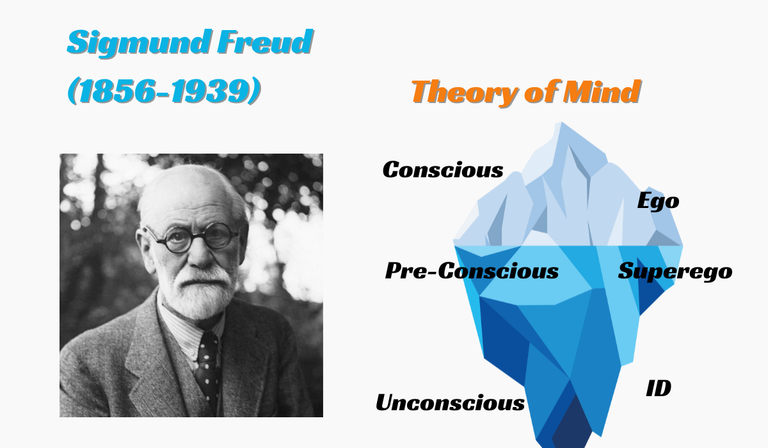
The Sigmund Freud’s seminal work, The Ego and the Id, explaining complex psychological concepts in accessible language. Freud revolutionized psychology by introducing the idea that the human mind is not solely governed by conscious thought but deeply influenced by the unconscious mind, which houses hidden desires, fears, and conflicts. The mind is divided into three parts: the Id (primitive desires seeking immediate pleasure), the Ego (the rational mediator balancing reality and desires), and the Superego (the moral conscience imposing societal values and guilt). The interaction and conflict among these three components shape human behavior, emotions, and mental health.

Freud’s iceberg metaphor illustrates that the conscious mind is just the visible tip, while the vast unconscious lies beneath, controlling our thoughts and actions in subtle ways. Repression of socially unaceptable desires and painful experiences in childhood leads to unconscious conflicts manifesting as dreams, slips of tongue, anxieties, and behavioral patterns.
 source
The Ego, far from being a fully independent decision-maker, is influenced by the raw impulses of the Id, the strict judgments of the Superego, and the demands of external reality. This constant tension can cause psychological distress, but a psychologically healthy person develops a strong Ego capable of balancing these forces without being overwhelmed.
Freud also introduced two fundamental instincts: Eros (life instinct) driving connection, creativity, and survival, and Thanatos (death instinct) associated with destruction, aggression, and self-sabotage. These instincts perpetually interact within the mind, influencing behavior and mental health. A mature Ego recognizes and channels these instincts constructively.
Ultimately, Freud’s work encourages deep self-awareness by understanding the ongoing internal struggles between primal desires, moral demands, and reality. This understanding forms the foundation for psychological healing and self-mastery, highlighting that human nature is far more complex than mere conscious thought.
HIGHLIGHTS
🧩 Unconscious Mind Controls Much More Than Conscious Thought: Freud’s groundbreaking insight is that the conscious mind is just a small part of mental functioning, with the unconscious harboring desires, fears, and memories that shape behavior without awareness. This challenges the common assumption that we are fully rational agents and opens up the study of hidden mental processes critical in psychology and neuroscience today.
🎭 Id, Ego, and Superego Represent Dynamic Internal Forces: The Id embodies raw, primal impulses driven by pleasure principle; the Ego acts as a pragmatic mediator operating on reality principle; and the Superego functions as an internalized moral judge. Their constant push-pull creates the internal psychological drama that explains human conflict, guilt, anxiety, and decision-making complexity.
❄️ The Iceberg Metaphor Simplifies Complex Psychological Structure: Visualizing the mind as an iceberg—with a small conscious tip and the vast unconscious submerged—makes it easier to grasp how most mental processes are hidden yet influential. This model remains foundational in psychoanalysis and cognitive sciences studying implicit cognition.
🛠️ Defense Mechanisms Are Ego’s Tools for Managing Conflict: Repression, denial, projection, and displacement are methods the Ego uses to protect the conscious self from painful unconscious impulses or societal condemnation. While these mechanisms offer temporary relief, overreliance can cause psychological symptoms and prevent genuine self-understanding.
⚔️ Ego’s Struggle With Dual Masters—Id and Superego—Generates Anxiety: The Ego is caught between satisfying instinctual drives and adhering to moral codes. When either master dominates excessively, mental health deteriorates: a weak Ego leads to impulsivity or psychosis, while an overbearing Superego causes guilt, depression, or self-criticism.
🔄 Life (Eros) and Death (Thanatos) Instincts Represent Fundamental Human Drives: Freud’s conceptualization of these opposing instincts as complementary forces highlights the complex nature of human motivation, including creativity, love, aggression, and self-destructive tendencies. Modern psychology and neuroscience echo these themes in reward circuits and stress responses.
🌱 Psychological Maturity Involves Recognizing and Balancing Internal Conflicts: True self-awareness begins when the Ego understands its subordinate position, acknowledges unconscious influences, and learns to mediate between primal desires, moral imperatives, and external reality. This mature balancing act is essential for mental well-being and personal growth.
THANKYOU