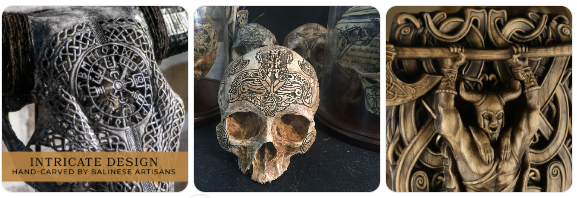
Fair point, and you're right to question popular myths — a lot does get exaggerated. Still, skull symbolism did exist in Europe, though often more subtly.
For example:
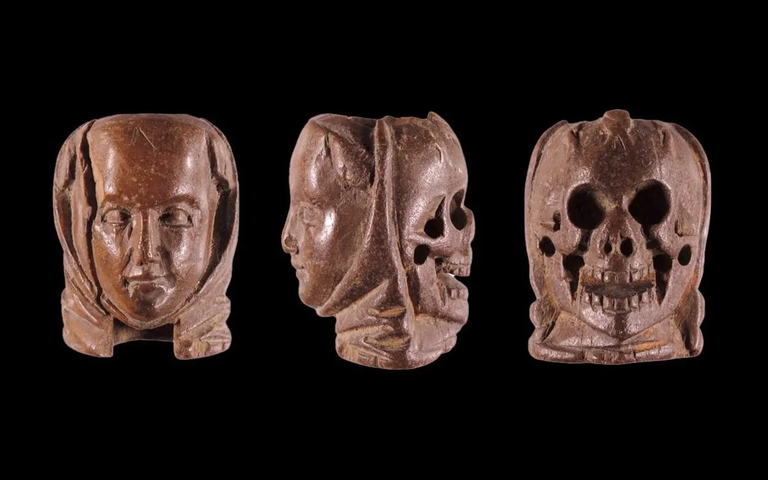
The carved rosary bead was discovered at Queenhithe in the City of London with a face on one side and a skull on the other. Credit: The Trustees of the British Museum
In Greek culture, while literal skulls were rare in art, Thanatos (death) was often depicted with a skull or winged skull motif in later Hellenistic funerary art.
Celtic cultures are more direct — Roman sources like Diodorus Siculus mention Celts collecting and displaying enemies’ heads, which likely inspired later skull motifs.
While direct carvings of human skulls in Viking art are indeed rare, one notable archaeological example is the Ribe skull fragment discovered in Denmark. This mid-8th-century artifact is a section of a human skull, approximately 6 x 8.5 cm in size, with a hole bored into it, suggesting it was worn as an amulet. The skull fragment is inscribed with runes invoking deities such as Odin and Tyr, indicating its use in rituals aimed at protection against illness or malevolent forces. ttps://en.wikipedia.org/wiki/Ribe_skull_fragment
Another example is the Danish Runic Inscription 66, also known as the "Mask Stone," discovered in Aarhus, Denmark. This granite runestone from around 1000 CE features a depiction of a facial mask and an Old Norse runic inscription mentioning a battle between kings. The mask depicted has been explained by the Moesgård Museum as "probably intended to be protection against evil spirits." https://en.wikipedia.org/wiki/Danish_Runic_Inscription_66
These artifacts illustrate that while explicit skull carvings are uncommon in Viking art, the human skull was utilized symbolically in various forms, including as amulets and in runic inscriptions, reflecting its cultural and spiritual significance.
Hollywood definitely amplified the visuals, the roots go back much further than most people realize.