
Today, almost no one visits them, so few know that on this other side of the Ucero River, the ancient ruins of the Celtiberian-Roman city of Uxama were, in fact, the origin of one of the most beautiful and culturally rich towns of that Numantian Celtiberia, which still, after that uninterrupted succession of unfinished chapters of History that are the centuries, continues to celebrate around the bonfires on Saint John's Eve: El Burgo de Osma.

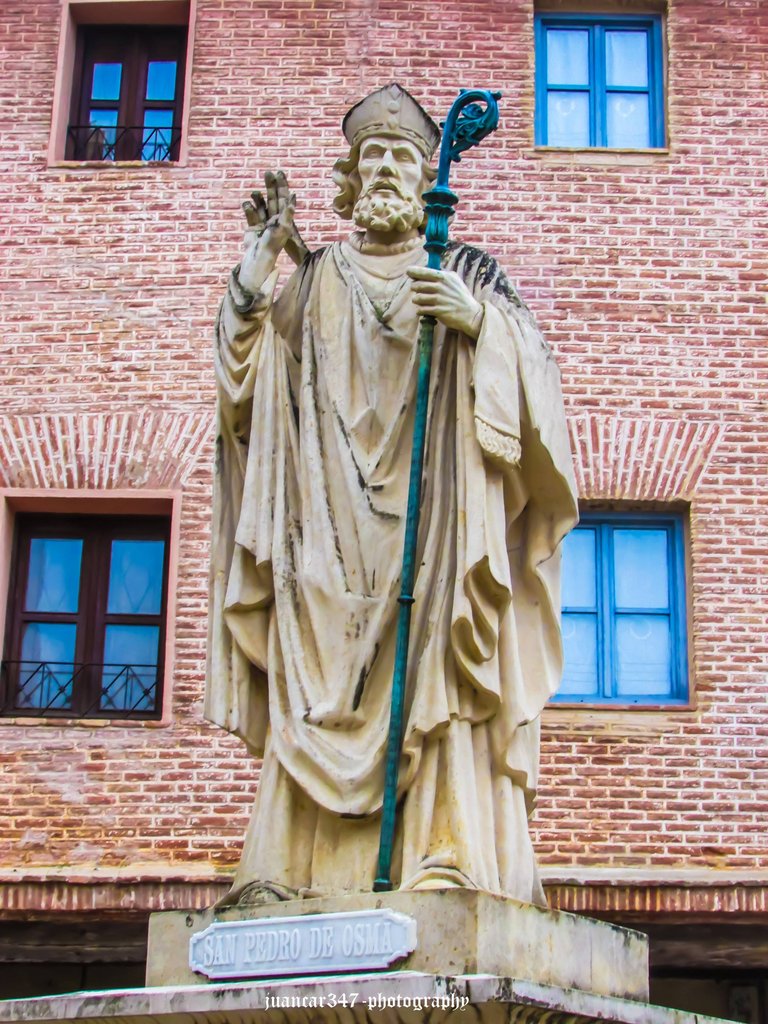
Under the unwavering gaze of Saint Peter of Osma, whose imposing statue guides visitors and pilgrims toward that enigmatic, multi-era structure of diverse styles, of lost and rediscovered clues among its assembled stones, of little-known mysteries and generally undervalued treasures that is its cathedral, the traveler, enveloped by the hieratic gaze of the Patron Saint, a beautiful Romanesque-Gothic carving of Our Lady of the Thorn—whose title recalls the difficult path chosen by Hermann Hesse to escape the soporific influence of the Matrix—feels, after all, like Alice in Wonderland.
And this is no metaphor, for wonders are truly what he beholds, with eyes that, as they wander through the nave or traverse the profound solitude of the cloister, in search of the original Romanesque remains and the formidable, illuminated, and polychrome tomb of the legendary patriarch, the aforementioned Saint Peter of Osma, feel, perhaps for the first time on his journey, decidedly greedy, contemplating a past that is simply spectacular and, ultimately, sadly, largely unknown.

Hoy casi nadie las visita, de manera, que pocos conocen que a esta otra vertiente del río Ucero, las viejas ruinas de la ciudad celtíbero-romana de Uxama, fueron, en realidad, el origen de una de las villas más hermosas y culturales de esa Celtiberia numantina que todavía, al cabo de esa sucesión ininterrumpida de capítulos inconclusos de la Historia, que son los siglos, continúa danzando alrededor de las hogueras en la noche de San Juan: el Burgo de Osma.

Bajo la impertérrita mirada de San Pedro de Osma, cuya imperiosa estatua señala a visitantes y peregrinos el camino hacia ese enigmático mecano de épocas y estilos diversos, de claves perdidas y reencontradas entre sus ensamblados sillares, de enigmas poco conocidos y de tesoros, generalmente infravalorados, que es su catedral, el viajero, arropado por la hierática mirada de la Patrona, una hermosa talla, románico-gótica, de la Virgen del Espino –cuya advocación recuerda el camino difícil elegido por Hermann Hesse para evadir la soporífera influencia de la Matrix- se siente, después de todo, como Alicia en el País de las Maravillas.

Y no es metáfora, puesto que maravillas son lo que realmente contempla, con unos ojos, que, a medida que se deslizan por la nave o atraviesan esas cardinales soledades del claustro, en busca de los restos románicos originales y el formidable sepulcro ilustrado y policromado del legendario patriarca, el mencionado San Pedro de Osma, se sienten, quizás por primera vez a lo largo de su viaje, decididamente golosos, pensando en un pasado, sencillamente espectacular y en el fondo, desgraciadamente muy desconocido.

NOTICE: Both the text and the accompanying photographs are my exclusive intellectual property and are therefore subject to my copyright.
AVISO: Tanto el texto, como las fotografías que lo acompañan, son de mi exclusiva propiedad intelectual y por lo tanto, están sujetos a mis Derechos de Autor.
